
Self-Coacervation of a Silk-Like Protein and Its Use As an Adhesive for Cellulosic Materials
P. Mohammadi, G. Beaune, B. T. Stokke, J. V. I. Timonen, M. B. Linder
ACS Macro Lett. 2018 7(9) 1120 https://doi.org/10.1021/acsmacrolett.8b00527
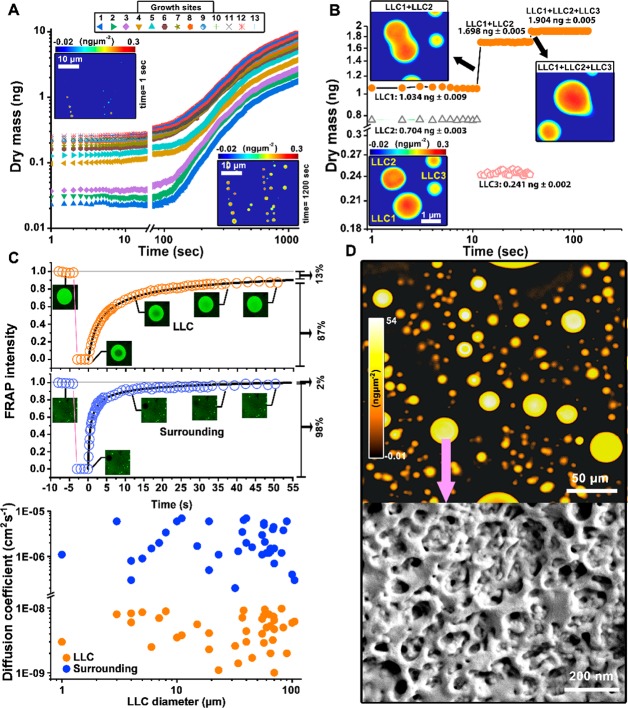
Liquid-liquid phase separation of biomacromolecules plays a critical role in many of their functions, both as cellular components and in structural assembly. Phase separation is also a key mechanism in the assembly of engineered recombinant proteins for the general aim to build new materials with unique structures and properties. Here the phase separation process of an engineered protein with a block-architecture was studied. As a central block, we used a modified spider silk sequence, predicted to be unstructured. In each terminus, folded globular blocks were used. We studied the kinetics and mechanisms of phase formation and analyzed the evolving structures and their viscoelastic properties. Individual droplets were studied with a micropipette technique, showing both how properties vary between individual drops and explaining overall bulk rheological properties. A very low surface energy allowed easy deformation of droplets and led to efficient infiltration into cellulosic fiber networks. Based on these findings, we demonstrated an efficient use of the phase-separated material as an adhesive for cellulose. We also conclude that the condensed state is metastable, showing an ensemble of properties in individual droplets and that an understanding of protein phase behavior will lead to developing a wider use of proteins as structural polymers.