
ER membranes exhibit phase behavior at sites of organelle contact
Christopher King, Prabuddha Sengupta, Arnold Y. Seo, and Jennifer Lippincott-Schwartz
PNAS 2020 117(13) 7231 https://doi.org/10.1073/pnas.1910854117
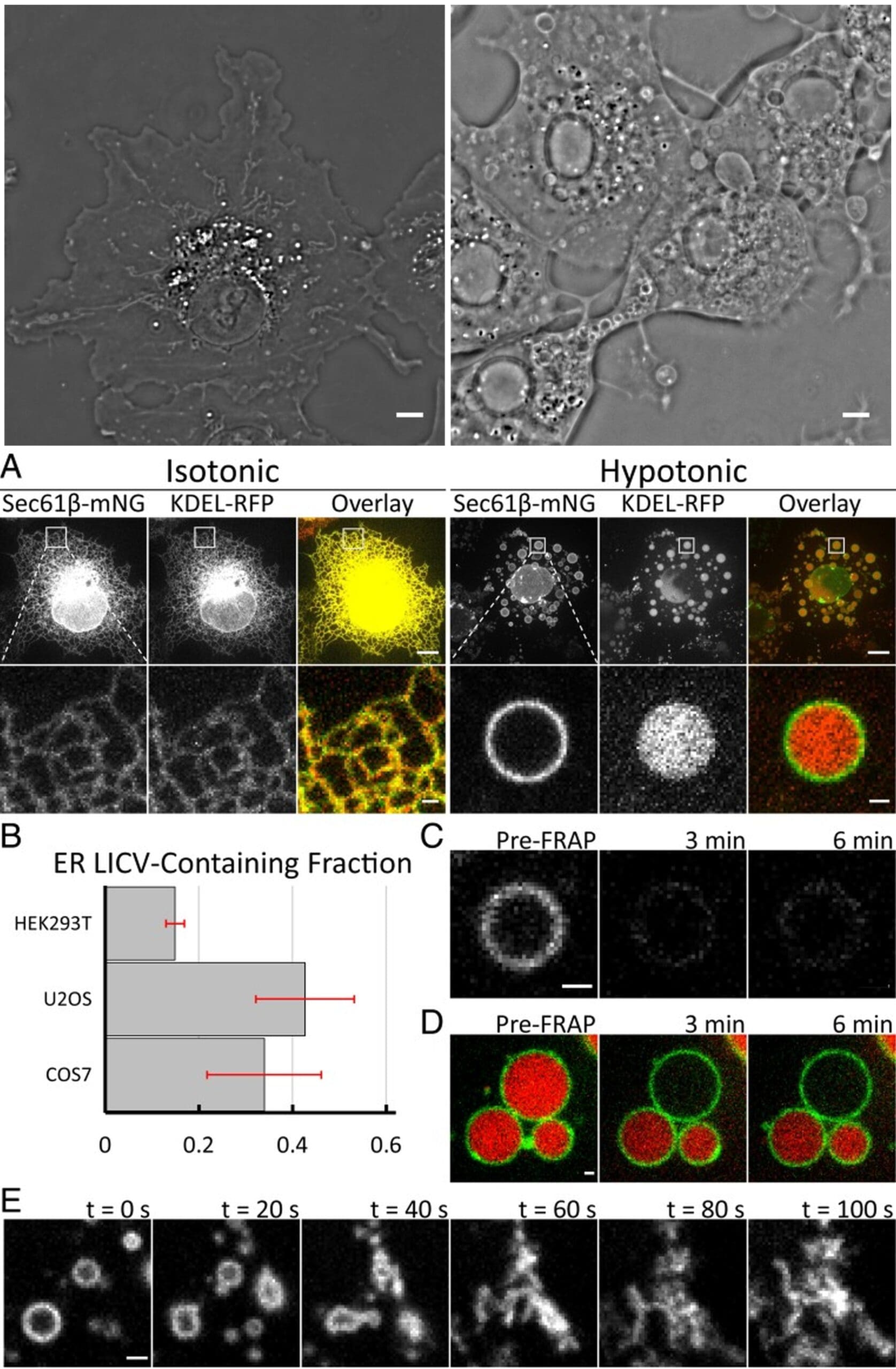
The endoplasmic reticulum (ER) is the site of synthesis of secretory and membrane proteins and contacts every organelle of the cell, exchanging lipids and metabolites in a highly regulated manner. How the ER spatially segregates its numerous and diverse functions, including positioning nanoscopic contact sites with other organelles, is unclear. We demonstrate that hypotonic swelling of cells converts the ER and other membrane-bound organelles into micrometer-scale large intracellular vesicles (LICVs) that retain luminal protein content and maintain contact sites with each other through localized organelle tethers. Upon cooling, ER-derived LICVs phase-partition into microscopic domains having different lipid-ordering characteristics, which is reversible upon warming. Ordered ER lipid domains mark contact sites with ER and mitochondria, lipid droplets, endosomes, or plasma membrane, whereas disordered ER lipid domains mark contact sites with lysosomes or peroxisomes. Tethering proteins concentrate at ER-organelle contact sites, allowing time-dependent behavior of lipids and proteins to be studied at these sites. These findings demonstrate that LICVs provide a useful model system for studying the phase behavior and interactive properties of organelles in intact cells.